
Shiny and reflective
Machined, polished and chromed metal reflects light like a mirror: bright hot spots and holes in the data.
Accessories · AESUB
Shiny, transparent and dark surfaces are hard for any optical scanner. A few microns of vanishing spray make them scannable, then disappear on their own. No residue, no cleaning.
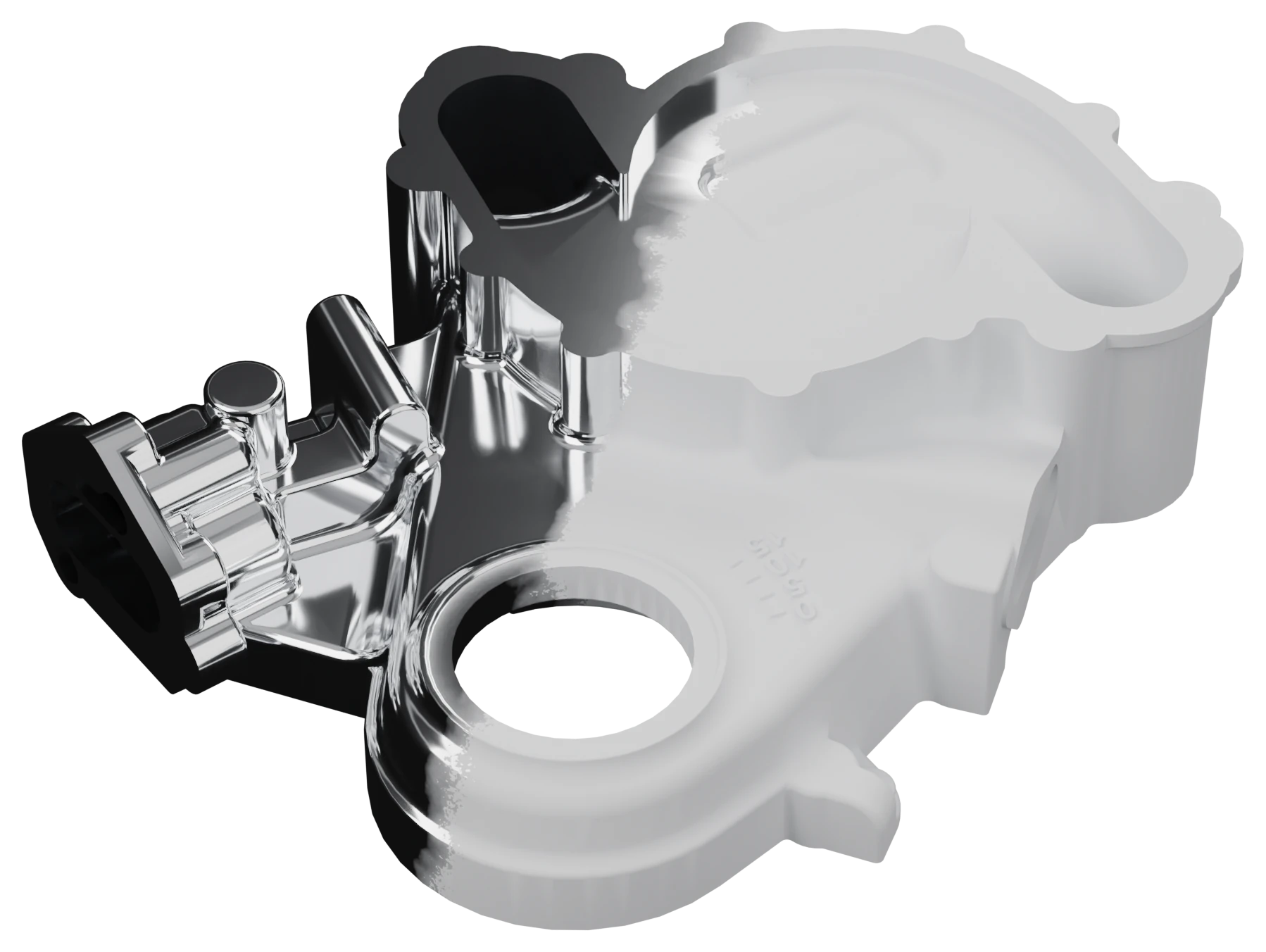
Left, without spray: reflections the scanner can't readRight, with AESUB: an even, matte surface
Why spray
An optical scanner measures the light its projector or laser sends out and its cameras see coming back. A thin, matte, even coat turns every surface into one the cameras can read.
Machined, polished and chromed metal reflects light like a mirror: bright hot spots and holes in the data.
Glass, clear plastics and lenses let the light pass straight through, so there is no surface to measure.
Black plastics, rubber and anodised parts absorb most of the light and return a weak, noisy signal.
A matte coat scatters the light evenly in every direction. Both cameras see it, and the scan is complete.
The lineup
Every vanishing spray leaves a white, sublimating coat. The difference is how long it stays scannable, how thin it is and how fast it disappears.
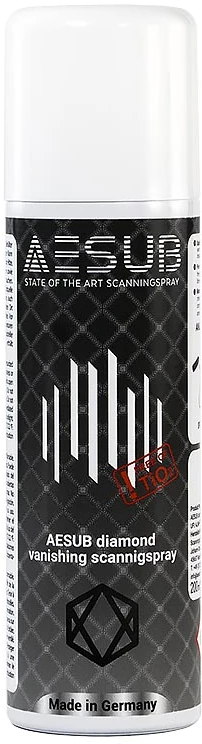
Ultra-fast and ultra-thin
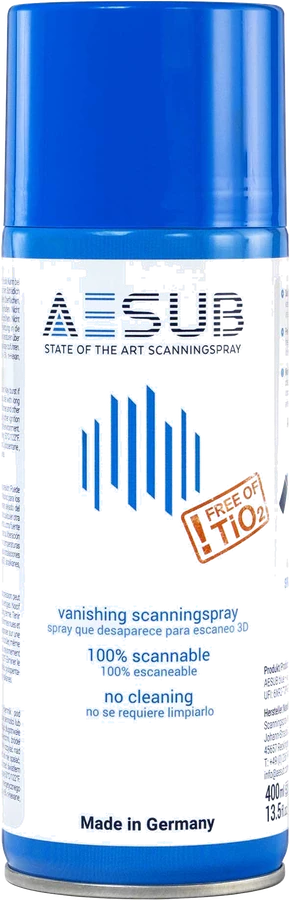
The everyday vanishing spray
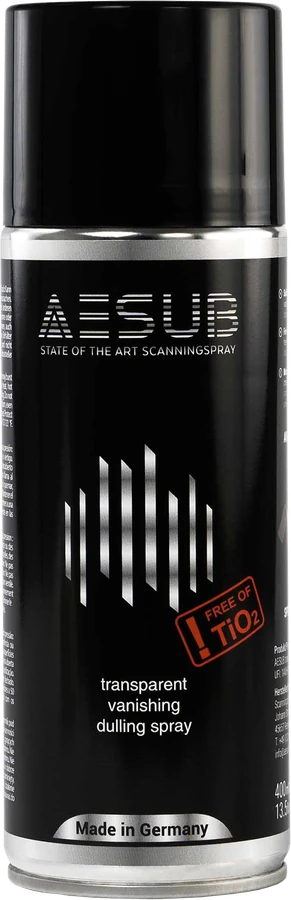
Clear coat, keeps the colour
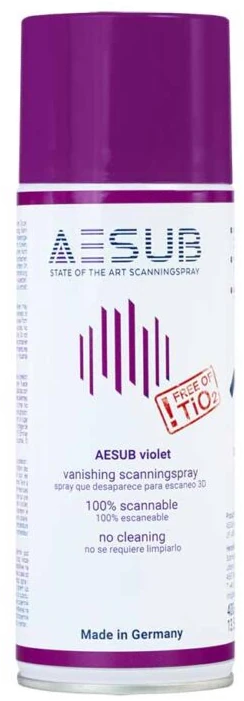
Longer jobs, thinner coat
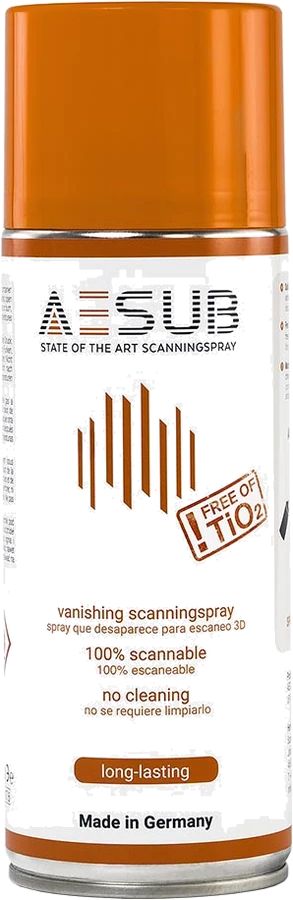
Long-lasting, for big parts
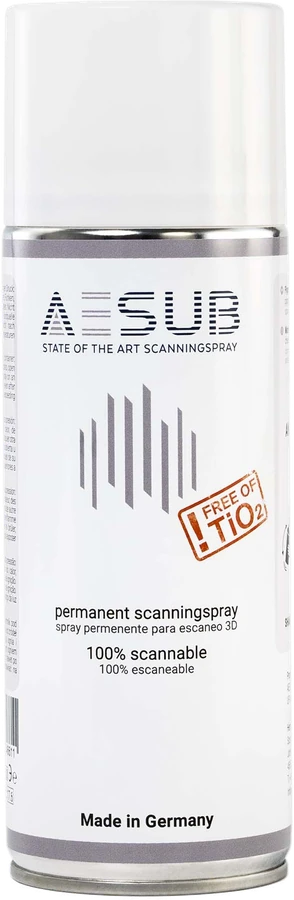
Permanent, titanium-dioxide-free
Compare
Times at about 21 °C; warmer rooms make the sprays vanish faster.
AESUB diamondAESUB blueAESUB transparentAESUB violetAESUB orangeAll six at a glance
| diamond |
blue |
transparent |
violet |
orange |
white | |
|---|---|---|---|---|---|---|
| Coating | White, vanishing | White, vanishing | Clear, vanishing | White, vanishing | White, vanishing | White, permanent |
| Scanning time | approx. 10 min | approx. 1–2 h | approx. 1–2 h | approx. 2–6 h | approx. 4–8 h | Unlimited |
| Vanishes after | approx. 15–30 min | approx. 4 h | approx. 4 h | approx. 24 h | approx. 12–24 h | Does not vanish; easy to remove |
| Layer thickness | 2 µm | 8–15 µm | 15–20 µm | 4–8 µm | 2–6 µm | 7 µm |
| Pigment-free | Yes | Yes | Yes | Yes | Yes | TiO₂-free |
| Best for | Quick checks, small parts | Everyday scanning | Scans with colour texture | Longer jobs, fine detail | Large parts, full-day jobs | Parts that may keep the coat |
Data from AESUB product documentation. Times are approximate and depend on temperature, airflow and layer thickness.
How to use
Clean and dry the part. Shake the can well and, if possible, work at room temperature.
Hold the can 15–20 cm from the surface and spray in even, overlapping strokes. Several thin passes beat one heavy one.
Start as soon as a stable, even white coat has formed. Place reference points on top of the coat if needed.
The vanishing sprays sublimate by themselves. No washing, no wiping, no residue on the part.
A thinner coat means less added material on the measured surface. Diamond and orange are the thinnest.
Warm parts and warm rooms shorten the scanning window. Plan big jobs with violet or orange.
Often only the shiny or clear areas need a coat. Mask the rest and save time.
FAQ
Every coat adds a little thickness. AESUB vanishing sprays are applied in layers of about 2–20 µm depending on the product, so choose a thin spray such as diamond or orange where it matters, and spray in thin passes.
Yes. Blue, violet, orange, transparent and diamond sublimate into the air after their scanning time. Only AESUB white is permanent and has to be removed.
Use AESUB transparent. It forms a clear coat, so a colour-capable scanner still sees the part's own colour.
The colour of the can only marks the product. All vanishing sprays except transparent leave a white coat.
Yes. Apply the spray first, then place the reference points. For targets that leave no adhesive residue, see our scanning setups.
Yes. Tell us which sprays and how many cans you need, and we send you an offer.
Order
Single cans or cases, for your scanner and your parts. Not sure which one? Tell us what you scan and for how long.
AESUB is a trademark of its owner. Product images: AESUB. ZEISS, T-SCAN, ATOS and GOM are trademarks of Carl Zeiss AG and its subsidiaries. Technical data per manufacturer documentation.